
The short version
Two organisations run the system. The VCAA runs the VCE itself (subjects, exams and study scores), and VTAC calculates the ATAR.
Only Units 3 and 4 count towards the ATAR. Units 1 and 2 are marked by the school and don't count, but the Units 3 and 4 content builds directly on them.
Each Unit 3 and 4 subject gives a study score out of 50. It is a ranking against every student in Victoria who took that subject, not a percentage. The average is 30.
A study score is built from three graded assessments. In Mathematical Methods and Specialist Mathematics these are the SACs (40%), Exam 1 (20%) and Exam 2 (40%).
SAC marks are moderated before they are used. Your rank in your school's cohort is kept, but the marks themselves are reset using the cohort's exam results.
The ATAR comes from your top four scaled study scores (including English) plus 10% of your fifth and sixth. The total is ranked against everyone else.
Want an actual number? The free ATAR calculator turns your study scores into an estimated ATAR using VTAC's scaling, and lets you pick any year from 2020 to 2025.
How a subject is assessed
Every Unit 3 and 4 subject has three graded assessments (GAs). Usually these are the Unit 3 SACs, the Unit 4 SACs and the end-of-year exam, but the split differs between subjects. In Methods and Specialist the three GAs are the Unit 3 and 4 SACs together, Exam 1 and Exam 2.
| Graded assessment | Weight | What it is |
|---|---|---|
| Unit 3 and 4 SACs | 40% | School-assessed coursework, set and marked by the school during the year, then moderated by the VCAA |
| Exam 1 | 20% | 1 hour plus 15 minutes reading time, 40 marks. No calculator and no notes; a formula sheet is provided |
| Exam 2 | 40% | 2 hours plus 15 minutes reading time, 80 marks: 20 multiple-choice questions plus extended-response questions. CAS calculator and one bound book of notes allowed |
Study scores
A study score is a number from 0 to 50 that shows where a student finished among everyone who took that subject in that year. In every subject, every year, the average is set at 30 and the standard deviation at 7, so most scores fall between 23 and 37.
| Study score | Approximate share of students at or above it |
|---|---|
| 45 | 2% |
| 40 | 9% |
| 35 | 26% |
| 30 | 53% |
| 25 | 78% |
| 20 | 93% |
How it is calculated
Each graded assessment is standardised: the state average is subtracted from the student's score and the result is divided by the state standard deviation. This is the student's z-score.
Each standardised score is multiplied by that assessment's weighting (in Methods: 40% for SACs, 20% for Exam 1 and 40% for Exam 2).
The weighted scores are added up, every student in the state is ranked on that total, and the ranking is placed on the 0 to 50 scale.
A real example: my Methods study score
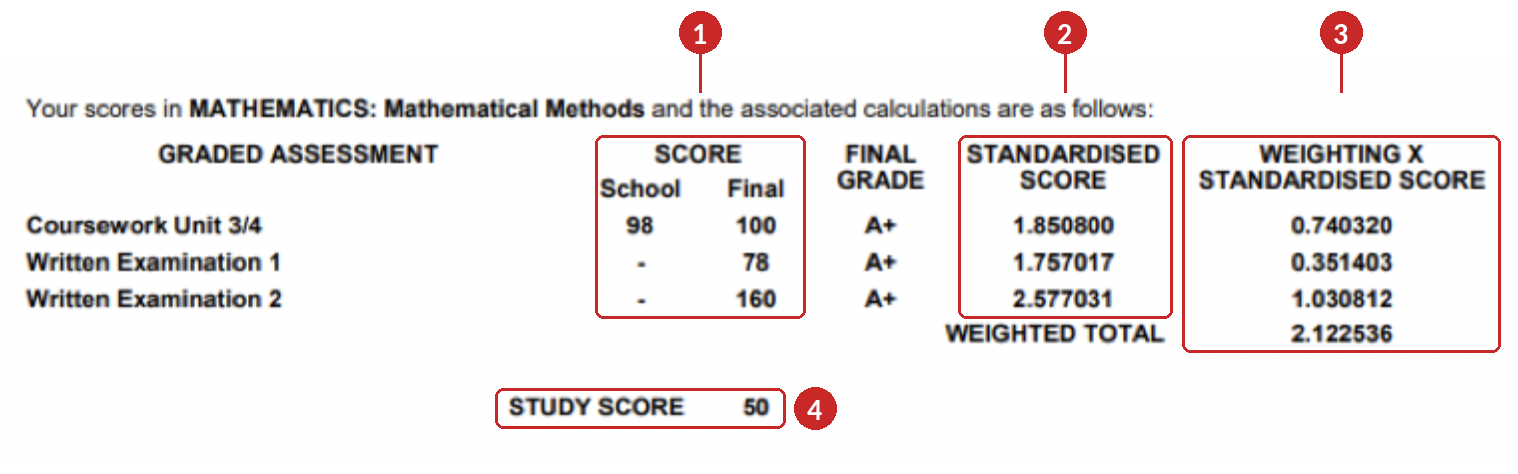
My Statement of Study Score for Mathematical Methods (raw 50)
Score. "School" is the coursework score my school submitted (98). "Final" is that score after moderation (100), along with my two exam scores.
Standardised score. How many standard deviations above the state average each score was. Exam 2 (2.58) was further above average than my SACs (1.85).
Weighting × standardised score. Each z-score multiplied by its weighting: 1.8508 × 0.4, 1.7570 × 0.2 and 2.5770 × 0.4. These add up to the weighted total of 2.1225.
Study score. The weighted total is ranked against every Methods student in the state, which gave a study score of 50.
What follows from this
A study score depends on how everyone else went, so the same exam mark can give a different study score from one year to the next.
One mark is not worth the same in every assessment. A mark counts for more where the state's results are bunched together and less where they are spread out.
A 40 in one subject and a 40 in another both mean "top 9% of that subject", but they don't mean the same thing for the ATAR until VTAC has scaled them.
Why SAC marks change: moderation
Schools write their own SACs and mark them to their own standard, so 80% at one school is not the same as 80% at another. The VCAA fixes this with statistical moderation: it puts each school's SAC marks onto the scale of that same group of students' exam results.
The simplest way to think about it: your SAC rank stays, but your SAC mark is replaced using the group's exam scores. The best exam score in the group goes to the student with the best SACs, the second best exam score goes to the student ranked second on SACs, and so on.
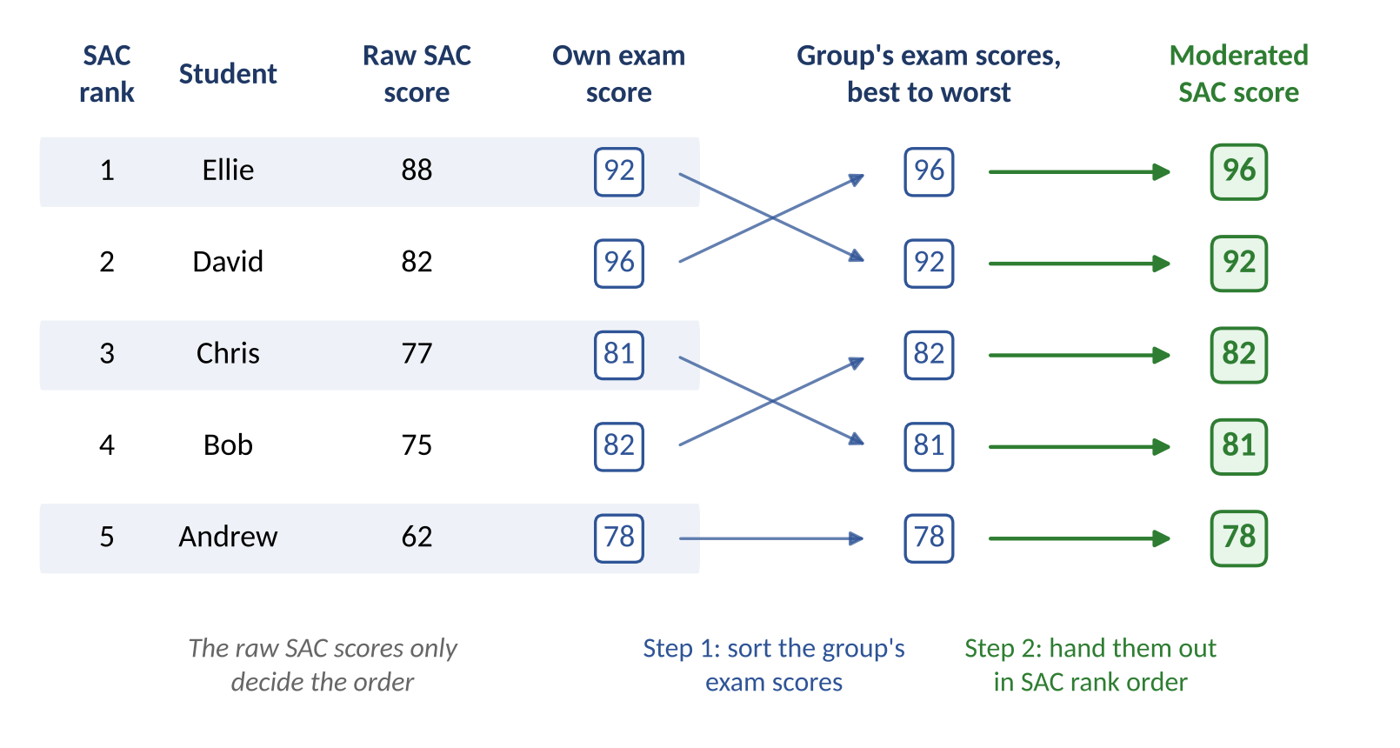
How moderation works, simplified: a school with five Methods students
Ellie had the best SACs (88) but David had the best exam (96). After moderation Ellie's SAC score becomes 96 and David's becomes 92, because Ellie was ranked first on SACs. Andrew's 62 becomes 78, the lowest exam score in the group. Nobody's SAC rank changes.
The catch: it is not an exact swap
The picture above is simplified. In reality the VCAA lines up the top score, the median and the quartiles of the group's SAC marks with those of the group's exam scores and fills in everything in between, so the gaps between students matter too, not just the order. Your moderated SAC score is also not your own exam score: it depends on how the whole group did. For example, two students with the same raw SAC score at different schools:
| Student | Raw SAC score | Own exam score | Moderated SAC score |
|---|---|---|---|
| William | 86 | 88 | 94 |
| Dan | 86 | 94 | 96 |
William's SAC score was moderated well above his own exam score because his group did well on the exam overall.
What this means in practice
Your rank and the gaps between you and the students around you matter more than the percentage. A hard SAC with a low class average does no harm, and an easy one with a high average does no good.
The cohort's exam results set the scale. If the group does well on the exam, everyone's moderated SAC marks go up, so it helps you when your classmates do well.
Your own exam doesn't move your own SAC result directly. The adjustment comes from the group, and your exam still counts in full on its own.
One bad exam in the class doesn't sink the group. Students who do far worse on the exam than expected are left out when the scales are lined up.
Small classes are combined with another school to form one group.
Some people speculate that the GAT (the General Achievement Test sat in June) also feeds into moderation or scaling. Even if it does, its weighting is likely to be very low, so it isn't worth worrying about.
The ATAR
The ATAR (Australian Tertiary Admission Rank) is a rank from 0 to 99.95 that compares a student with their whole age group. An ATAR of 80 means the student did better than 80% of their age group. VTAC works it out in three steps.
Scaling. VTAC adjusts each study score up or down depending on how strong the students in that subject are across all their other subjects. The result is a scaled study score.
The aggregate. VTAC adds your top four scaled scores (your best English score plus your next three best) and 10% of your bottom two (your fifth and sixth scores, if you have them).
The rank. Every student's aggregate is ranked and converted to an ATAR. VTAC publishes the aggregate-to-ATAR table on results day each year, and previous years' tables are easy to find online.
A worked example
A student's scaled scores are English 35, Specialist 45, Methods 40, Chemistry 38, Physics 36 and Biology 33.
Top four: 35 + 45 + 40 + 38 = 158
Bottom two: 10% of 36 + 10% of 33 = 3.6 + 3.3 = 6.9
Aggregate: 164.9, which is then looked up in that year's aggregate-to-ATAR table
Try it with your own subjects. The ATAR calculator does the scaling, the top four and the 10% for you. Type in your subjects and expected study scores to see your aggregate and estimated ATAR.
Methods and Specialist
Calculators
Exam 2 allows one VCAA-approved CAS calculator and one scientific calculator. No calculator is allowed in Exam 1, so every technique also has to be practised by hand.
A change from 2027
The VCAA will restrict custom functionality on CAS calculators, including user-defined functions (UDFs), in VCE Mathematics exams from 2027 (VCAA Notice to Schools 52, 28 May 2026). Students should learn to use the calculator's built-in commands only, which is how I teach.
The bound reference
For Exam 2 a student can bring one bound book of notes: a textbook, a securely bound lecture pad, an exercise book or a permanently bound set of their own notes, with no fold-outs. It can be annotated, and teachers check it at the door.
Scaling
Both subjects scale up, and Specialist scales up more. These figures are from the 2025 scaling report and change a little each year.
| Study score | Methods, scaled (2025) | Specialist, scaled (2025) |
|---|---|---|
| 30 | 35 | 43 |
| 35 | 41 | 48 |
| 40 | 46 | 51 |
| 45 | 49 | 54 |
These are from VTAC’s 2025 Scaling Report. Specialist assumes Methods is being studied at the same time or has already been done, and both can count in the top four for the ATAR.
What it takes to get a high study score
The question I get most from students and parents is what mark is actually needed on the exams for a 40, or a 45. The VCAA doesn't publish a conversion, because a study score is a ranking and the answer moves every year. It does publish enough to work it out roughly, so I did. The short answer for Methods: a 45 usually takes about 110 to 116 out of 120 across the two exams with SACs to match, a 40 takes about 95 to 105, and scraping an A+ in all three graded assessments is about a 40. The rest of this section shows where those numbers come from, along with the same figures for Specialist.
Where these numbers come from
The VCAA's grade distributions for Methods (2022 to 2025) and Specialist (2024 and 2025). These show how many students in the state landed in each grade band for the SACs, Exam 1 and Exam 2, along with the state average and spread.
The VCAA's exam reports for the same years, which give the percentage of students who scored 0, 1, 2 and so on for every part of every question.
Real results from one school's 2023 Methods class (exam marks, moderated SACs and study scores), plus two results reported to me: in 2024, 118 out of 120 with perfect SACs was a raw 50 in Methods, and in 2025, 119 with SACs of 99 was a 49.
I used the grade distributions to simulate a whole state cohort, ran every simulated student through the study score calculation shown earlier in this guide, and adjusted the model until it matched the real results above. It lands within about one study score of each of them. Treat every number here as a guide, give or take a study score or two, not a promise. The Specialist figures come from the same model but I have no class results to check them against, so they are rougher.
Methods: exam marks needed for each study score
"Exam marks" means Exam 1 and Exam 2 added together, out of 120 (40 + 80). The table assumes the student's SACs were about as strong as their exams, which is the usual pattern. For a 48 or above that means SACs of 97 to 100 after moderation.
| Study score | 2022 | 2023 | 2024 | 2025 |
|---|---|---|---|---|
| 50 | 119 | 117 | 118 | 119 |
| 48 | 118 | 115 | 117 | 119 |
| 45 | 115 | 110 | 112 | 116 |
| 43 | 112 | 105 | 107 | 112 |
| 40 | 104 | 95 | 98 | 105 |
| 35 | 87 | 76 | 78 | 87 |
| 30 | 65 | 55 | 56 | 66 |
| 25 | 45 | 36 | 37 | 44 |
2023 had a hard Exam 2 (the A+ started at 61 out of 80), so every mark was worth more that year. 2022 and 2025 were easier at the top end, which is why 119 with SACs of 99 was "only" a 49 in 2025. A score of 50 needs SACs of 100 after moderation in every year.
Specialist: exam marks needed for each study score
Specialist is a much stronger group of students, so the same marks give a lower raw score than in Methods. VTAC then scales Specialist up a long way to make up for it (see the scaling table above).
| Study score | 2024 | 2025 |
|---|---|---|
| 50 | 119 | 120 |
| 48 | 118 | 119 |
| 45 | 115 | 118 |
| 43 | 111 | 115 |
| 40 | 104 | 110 |
| 35 | 89 | 97 |
| 30 | 68 | 78 |
| 25 | 46 | 55 |
2025 Specialist was the easiest paper in this data by a long way. No part of any question had fewer than 16% of students getting full marks, and the Exam 2 A+ started at 76 out of 80. In a year like that the gap between a 40 and a 45 is about eight marks, and most of those are careless errors rather than hard questions.
How much SACs matter
Below the very top, one point of moderated SAC score (out of 100) is worth almost exactly one exam mark (out of 120), in both subjects. At the very top, SACs decide who gets the 50. This table shows Methods study scores for different combinations, using the 2025 statistics. In a harder year like 2023, add one or two to the top rows.
| Exam marks (out of 120) | SACs 100 | SACs 97 | SACs 95 | SACs 90 | SACs 85 | SACs 80 |
|---|---|---|---|---|---|---|
| 120 | 50 | 48 | 46 | 44 | 42 | 41 |
| 118 | 49 | 46 | 45 | 43 | 42 | 41 |
| 116 | 47 | 45 | 44 | 43 | 41 | 40 |
| 112 | 45 | 44 | 43 | 42 | 40 | 39 |
| 110 | 44 | 43 | 42 | 41 | 40 | 39 |
| 104 | 42 | 41 | 41 | 40 | 39 | 38 |
| 100 | 41 | 40 | 40 | 39 | 38 | 37 |
| 90 | 39 | 38 | 38 | 37 | 36 | 35 |
| 80 | 37 | 37 | 36 | 35 | 35 | 34 |
Two things stand out. With SACs of 95, even a perfect 120 on the exams is only about a 46. And a student with SACs of 100 can drop around 8 marks across the two exams and still get about a 45.
Real results: one Methods class in 2023
These are actual results from one Melbourne school's 2023 Methods class, for the students whose exam marks I know. The model's estimate for each of them is within about one study score.
| Exam marks (out of 120) | SACs after moderation | Study score |
|---|---|---|
| 119 | 100 | 50 |
| 119 | 100 | 50 |
| 112 | 100 | 47 |
| 111 | 97 | 45 |
| about 108 | 100 | 44 |
| 107.5 | 99 | 44 |
| 112 | 91 | 43 |
| 112 | 89 | 43 |
| 96 | 99 | 42 |
Look at the three students on 112. The one with SACs of 100 got a 47, and the two with SACs around 90 got a 43. Same exam marks, four study scores apart.
Letter grades
The Statement of Results gives a letter grade (A+ down to E, or UG) for each of the three graded assessments. The cut-offs move each year with the difficulty of the paper. About 8 to 10% of the state gets an A+ on each Methods exam, and about 7% on each Specialist exam. These are the lowest marks that got an A+ or an A.
| Exam 1 A+ (out of 40) | Exam 1 A | Exam 2 A+ (out of 80) | Exam 2 A | SACs A+ (out of 100) | |
|---|---|---|---|---|---|
| Methods 2022 | 37 | 32 | 70 | 61 | 92 |
| Methods 2023 | 37 | 32 | 61 | 51 | 94 |
| Methods 2024 | 33 | 28 | 67 | 56 | 93 |
| Methods 2025 | 36 | 32 | 70 | 61 | 91 |
| Specialist 2024 | 37 | 33 | 71 | 64 | 88 |
| Specialist 2025 | 38 | 34 | 76 | 71 | 91 |
The VCAA reports exam scores doubled (Exam 1 out of 80, Exam 2 out of 160), so I have converted them back to raw marks. The SAC grade is based on the moderated score. One useful rule of thumb: scraping an A+ in all three graded assessments works out to about a 40 in both subjects, every year in this data.
How hard the questions are
The exam reports show what share of the state got full marks on every part of every question. Sorting all 120 marks by that share shows how the papers are built. Each number below is a count of marks out of 120, and each multiple-choice question counts as one mark.
| Share of students with full marks | 70% or more | 30 to 70% | 15 to 30% | Under 15% |
|---|---|---|---|---|
| Methods 2022 | 25 | 66 | 25 | 3 |
| Methods 2023 | 9 | 65 | 26 | 20 |
| Methods 2024 | 18 | 67 | 16 | 19 |
| Methods 2025 | 27 | 62 | 25 | 6 |
| Specialist 2024 | 18 | 78 | 16 | 8 |
| Specialist 2025 | 31 | 77 | 12 | 0 |
2022 adds up to 119 because the VCAA later withdrew one part of Exam 2.
Most of every paper is standard. Between 74 and 91 of the 120 Methods marks, and around 100 of the Specialist marks, are on parts that at least 30% of the state gets completely right.
Only a handful of marks are genuinely hard: under 10 marks on parts that fewer than 15% of students got fully right in four of the six papers, and about 20 in Methods 2023 and 2024.
The very hardest parts are solved by almost nobody: 3% of students got full marks on 2023 Methods Exam 2 Question 3h, 2% on 2024 Methods Exam 1 Question 5b, and 4% on 2025 Methods Exam 1 Question 9b(ii).
What this means
Put the two halves together. Leave the hardest four marks blank, get everything else right, and you are on 116 out of 120. With full SACs that is roughly a 47 to 49 in Methods, depending on the year.
So past a certain level, VCE maths stops being a test of whether you can do the maths and becomes a test of whether you can do it reliably under time pressure. Going from a 42 to a 47 in Methods takes about 8 to 12 more exam marks, and for most students those marks are not on the hard questions. They go on misread questions, rounding to the wrong number of places, a missing domain or dx, arithmetic slips in Exam 1 and running out of time in Exam 2. A careless mistake on an easy part costs exactly as much as skipping the hardest question on the paper.
It also explains what kind of practice works. VCE maths repeats itself: the same ideas come back every year in slightly different forms, so a big set of questions sorted by topic is far more efficient than practice exam after practice exam. Practice exams still matter, but their real job is training timing and technique once the content is solid. That is how I run lessons: topic question sets first, then timed papers, with every lost mark written into a mistake log so the same mistake doesn't cost marks twice.
See what marks you need. The study score calculator turns your SAC and exam marks into an estimated Methods or Specialist study score, using VCAA's grade data.
Common questions
A SAC came back at 65%. Is that bad?
The percentage alone doesn't tell you. What matters is where the mark sits in the school's cohort, because moderation keeps the rank order and resets the scale. Ask the teacher for your rank, or for the class average and top mark.
Does one bad SAC ruin a study score?
No. In Methods all the SACs together are 40% of the study score, and one task is only part of that. A poor result moves your SAC ranking a little; it doesn't decide the final score.
Does it matter how strong the school's cohort is?
Only for the SAC part. A cohort that does well on the exams lifts everyone's moderated SAC marks. The exams, which are 60% in Methods, are marked the same way for every student in the state.
Are a mark in Exam 1 and a mark in Exam 2 worth the same?
Not exactly. Exam 2 carries twice the weighting and twice the marks, and each exam is standardised separately, so the value of one mark depends on how spread out the state's results were on that paper.
Should subjects be chosen for how they scale?
No. Scaling adjusts for the strength of the students in a subject, so a student who would rank lower in a high-scaling subject gains nothing by choosing it. Choose subjects for prerequisites, ability and interest.
Do Year 11 results count towards the ATAR?
Units 1 and 2 don't. A Unit 3 and 4 subject taken early in Year 11 does count, as one of the up to six subjects in the ATAR.
Where to check
Rules change, so these are the official pages this guide was checked against in November 2026.
Questions about any of this? Get in touch, or try the free ATAR and study score calculator, which uses the same data.